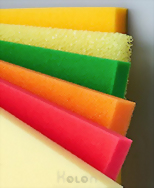
PU Polyester
PU Polyester-Professtional PU Polyester manufacturer and Supplier-KOLON

Abrasion Resistance Properties
There are two types of abrasion resistance sliding and impingement. Sliding refers to scraping and rubbing abrasion while impingement refers to particles or objects striking the urethane surface at a high angle.
Polyester has a high capacity for sliding abrasion resistance which makes it ideal for applications like scraper blades and chute liners.
Heat Resistance Properties
Both polyester and polyether urethanes perform well at elevated temperatures, however:
Polyesters withstand high temperatures longer and are more resistant to heat aging.
Low Temperature Flexibility
All elastomers (rubbers, urethanes, silicones, etc.) get harder and less flexible as temperatures drop and will eventually reach a temperature at which they become brittle. Urethane's brittle point is between -40°F and -100°F depending on the formulation.
Polyether is less affected by cold temperatures.
Hardness Properties
Both polyesters and polyether can be made to any hardness from marshmallow-soft to bowling ball hard.
Rebound Properties
Products such as skate wheels need to return the energy they absorb when your foot pushes them into the pavement (rebound); otherwise, you would feel like you are running in soft sand. Sand absorbs most of the energy from your foot and makes you run sluggishly.
Shock Absorption Properties
Sometimes you want the product to absorb the energy it receives (opposite of rebound).
Polyester is the choice for shock absorption and is used widely in vibration dampening applications.
RESISTANCE
Polyesters have higher tensile strength and higher cut and tear resistance than polyether.
Water and Moisture Resistance
If the product is to be submerged or used in a very humid condition it should be a Polyether because polyether has excellent hydrolytic stability.
Oil, Fuel and Solvent Resistance
If the product will encounter oils, fuel, or solvents (even vapors) your choice should be a Polyester as they are more resistant to attack from these harsh chemicals.